Moving frequently in Switzerland

How to organise a home that you already know you will be leaving
“Margot, is it really worth fixing up a house if I already know I'll be leaving in 1–2 years?”
From my point of view, I would say: absolutely yes.
I have moved many times in my life (four times in 2015 alone), but each time I felt the need to make the space I was living in my own. The only real exception was a temporary accommodation: I knew I would only be staying there for a month, waiting for my flat to become available. In that case, I limited myself to furnishing it in a basic and practical way, so that I could immediately find everything I needed for those 30 days.
Because living well does not depend on duration.
After a busy day at work, we need a place that welcomes us, that functions as a protective nest, calming and recharging us. But that's not all: our lives are made up of happy, sad, intense, boring and exciting moments. That's why, for me, it's essential to have a space that reflects me and enhances who I am, even though I know it won't be “forever”.
I remember, for example, a period when I lived in a guest room for only six months. I had a sofa bed, a wooden chest and a wardrobe. With the owner's permission, I bought inexpensive IKEA curtains with a natural linen effect, neutral sheets in soft colours that complemented the wood, a few small decorative details found in a brocante to drape the curtains, a wooden box used as a bedside table and a rope rug. With little expense, I transformed that room into a cosy, personal space that reflected my tastes.
Home as a place to recharge, not as a property investment
This concept is fundamental. Even on a physical and mental level: body and mind always work together, and when they do well, we feel it immediately.
If you experience your home as something that is yours — and not as a space to show off to your neighbours or on social media — it becomes easier to truly relax and enjoy those few, but necessary, hours of daily recharging.
“How can I feel ‘at home’ in a space that I didn’t really choose?”
Standard Swiss flats
I know: not everyone likes white, neutral or very standardised flats. I myself prefer more lived-in, perhaps older homes with lots of wood. The good news is that today, between second-hand shops and flea markets, it is possible to find beautiful items at affordable prices.
What really makes the difference, however, is knowing your own style: recognising the colours that make you feel good, the materials that reassure you, the atmosphere you
need.
Impersonal furnishings
In temporary flats, the furniture is often already there — and rarely reflects our taste. Let's face it: especially in big cities, we feel lucky just to have found a place to live. We cannot expect the finishes to be perfectly in line with our tastes.
But there are a few tricks.
Fabric, for example. Fabrics, covers, curtains, rugs: we can cover, frame and transform surfaces and furnishings. My advice is always to start with the existing colours and work with them. If, for example, there are black tiles, it is important to take them into account and work to soften them with warmer materials and shades.
Small gestures to create identity
Through moving house, I have learned to collect mainly objects that I feel are mine — for reasons of energy, not just aesthetics.
Rather than moving bulky furniture, I prefer to cover a sofa with a blanket I love, combine it with cushions collected over the years, and add a few key elements. With very few objects, it is possible to recreate the same style of living room practically anywhere.
“Every time I move house, I accumulate objects... but then they follow me everywhere. How can I understand what is truly essential?”
Objects that serve a purpose vs objects that provide reassurance
I regularly clean out drawers and cupboards, especially during the gloomiest periods: it helps me to calm my mind and bring lightness, not only into my home but also into myself.
The objects I need are few but functional: in the kitchen, for example, all I need are a few quality utensils that work really well. When I stop using something, I ask myself why. If the answer is that I have a better one, then the first one can go.
Reassuring objects, on the other hand, are those that warm your heart as soon as you look at them. They tell a story, a moment, a connection. When my grandmother passed away, I chose to keep only three or four objects: a rug that was in the entrance to her house, a symbol of welcome for me, and her linen bag for sheet music, which I now use for my paints and brushes. These are useful, beautiful and well-used objects. They don't bring her back to life, but they make my home more mine and, every time I see them, they bring a smile to my face.
What I don't consider essential are objects given to us by people we care about, but which don't represent us. You can feel it immediately: they strike a discordant note within us.
Emotional decluttering
It's difficult, but necessary.
Sometimes holding on to certain objects is like carrying around lots of little pebbles: harmless individually, but heavy over time. After a targeted decluttering session, I like to create a box with the objects that are most difficult to let go of. I take my time, alone, with the right music, maybe a herbal tea or a glass of wine.
I ask myself: why can't I let it go? What am I afraid might actually happen?
The truth is that we are the ones who give value to objects. When we enter someone else's home, we see inanimate things: it is the owner who imbues them with meaning. Changing our perspective helps us detach ourselves from material things and place more value on time and memories, which we can always move with ease.
Create an ‘essential core’ that accompanies you everywhere
Imagine you have to leave in a short time with only two suitcases: what would you really take with you?
The same applies to clothes: fewer items, but of higher quality. Chosen consciously, in line with your style. When I buy shoes or bags, I always take a long time: they must be beautiful, durable and adaptable to multiple occasions.
‘How can I organise cupboards and spaces without having to start all over again every time?’
An organisation that travels with you
My system is not universal: it is adapted to my habits. And I reproduce it in every home, with minor adjustments.
Kitchens change, but the gestures remain the same. Before a move, I don't just move the pots and pans: I recreate the same layout. The same goes for my desk: for years, the drawers on the left, the documents on the right, always with the same pattern.
These micro-habits save energy and make everything run more smoothly.
Flexible boxes and categories
I love boxes, preferably neutral and made of natural materials. Every cupboard or drawer is divided into intuitive categories. They are practical in everyday life and brilliant when moving house: everything is already classified.
That's why, after two weeks in a new home, it feels like I've been living there for months. For me, boxes lying around mean a waste of energy. We only have one life: let's use our time for more interesting things.
‘Does it make sense to buy furniture if I know it might not fit in my next home?’
It depends. There is no absolute right or wrong, only common sense.
Small, convertible pieces of furniture can become part of our style. I use an antique beehive as a bedside table or side table: despite its weight, it has been with me for ten years and has already seen six homes. The same goes for an old Swiss military suitcase, now converted into a coffee table and storage unit.
Yes to these purchases, as long as they are transportable (preferably by yourself). No, however, to overly large structures — such as beds or large wardrobes — unless there is a real possibility of reselling them.
For short stays (3–6 months), it is better to stick to the essentials. For a year or more, a certain level of comfort is appropriate, perhaps looking for solutions in second-hand items.
‘How can you avoid living for years with “temporary” boxes that then become permanent?’
Blocked energy
If you move often but some boxes are never opened, stop and ask yourself why you are taking them with you. What are you afraid of losing?
Memories live within us. Think about the objects we loved as children: we no longer have them, yet we grew up anyway.
The procrastination box
It exists, all right. Business cards, papers, accounts, “I'll think about it later”.
I solved this with a single drawer dedicated to paperwork:
everything ends up there, in no particular order
once a month, I empty it completely
anything that is no longer needed is thrown away
A simple method that restores peace of mind.
Temporary does not mean neglected
Living temporarily does not mean living poorly. I often think of the home as a well-kept hotel room: minimalist, but with attention to detail.
‘Every move stresses me out so much. Can my home help me instead of
tiring me out?’
Order = less decision fatigue
The nice thing about moving is the opportunity to lighten your load. If you can, spend an hour a week clearing out the unnecessary, room by room.
Simple spaces during periods of transition
Packing in advance, photographing the layout of the rooms, living with only the essentials for a while: all this makes the change gentler.
‘How can I furnish my home in a light-hearted way, without getting too attached but without living in a void?’
Balance between detachment and care
We are not our possessions. And they are not us.
Neutral but warm objects
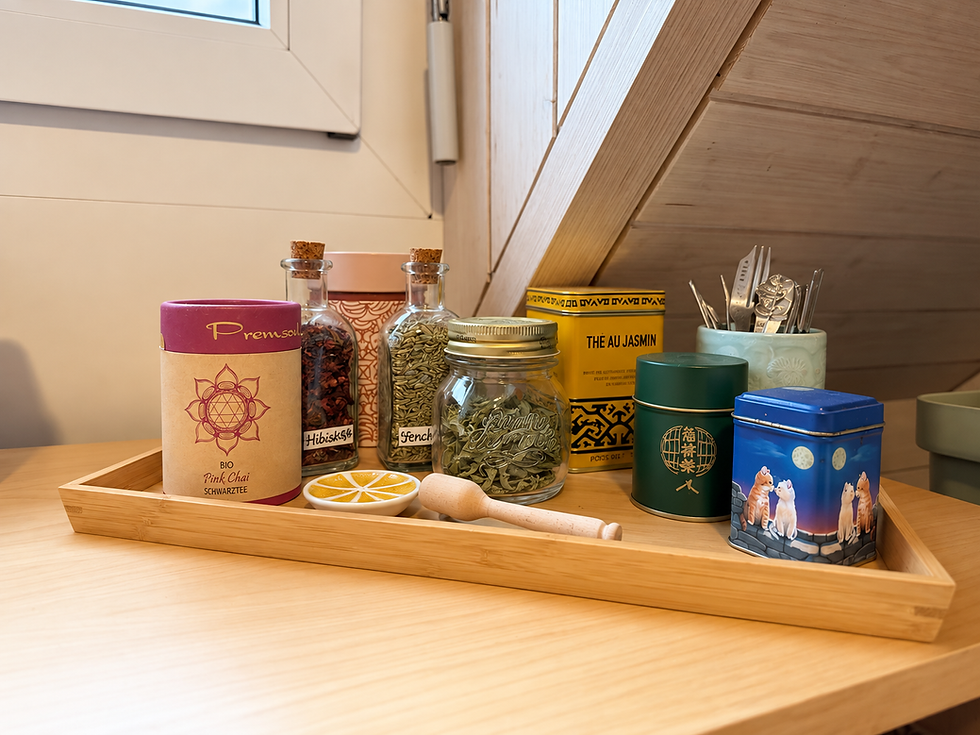
Authentic materials — wood, stone, metal, natural fabrics — convey warmth without weighing things down. Let's observe nature and be inspired.
Beauty that isn't heavy
Photographing a room helps us understand what creates heaviness: too many colours, too many styles. Sometimes it's not necessary to eliminate, but to choose a direction.
‘Is there a way to move house that is less traumatic, even emotionally?’
Closing rituals
When I had to leave homes I was very attached to, I invented a ‘dinner with the house’. Phone off, total presence, reliving every gesture and every memory. A way to say thank you and close the door gently.
If I had to give you just one rule for living well in temporary homes:
Live in the present with care. Do not put off your well-being until a future home, do not become attached to material things. Create spaces that support you here and now, because feeling at home is a daily practice, not a destination.
— House of Margot


Comments